
Every week in tech comes with new announcements by the likes of Microsoft, Google, Meta, or OpenAI around the new capabilities of AI models and the ever-increasing capacity of hyperscale data centers. However, with Megawatt-scale data center racks on the horizon, the rapidly growing energy demand of data centers is becoming a fundamental bottleneck to their growth. For consistent, local, and low-carbon energy, could the new generation of nuclear energy be the solution?
Small, Modular, and Ready to Scale
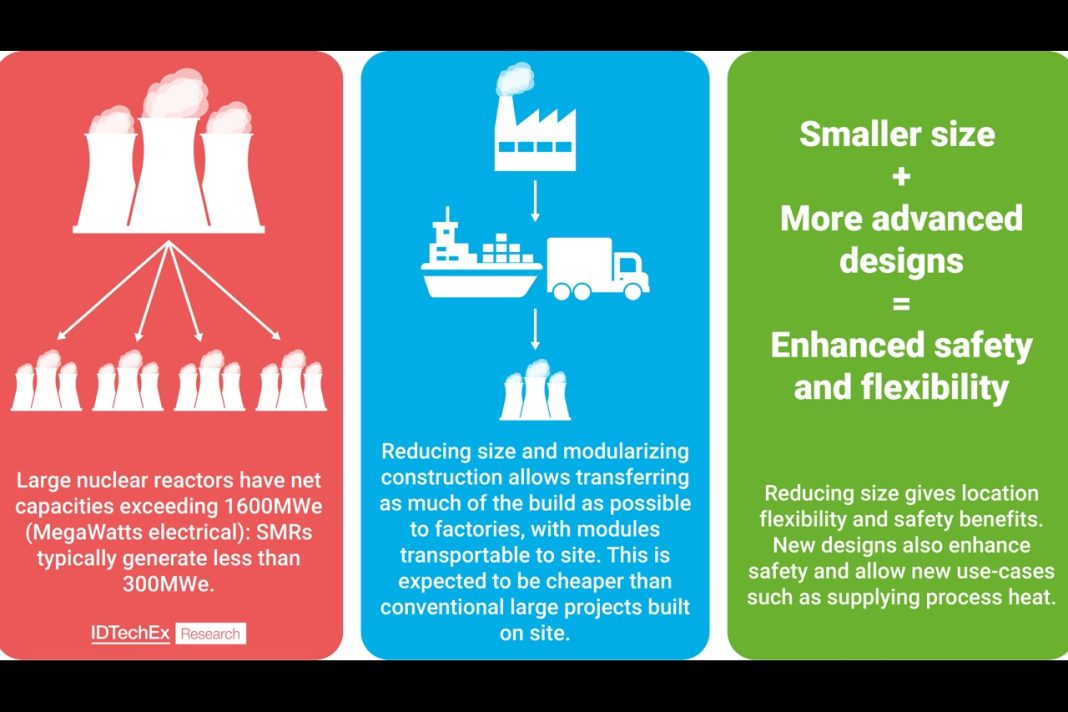
Small modular reactor (SMR) is a broad term for a compact nuclear fission reactor, typically any that fall below a 300MW electrical power output. Reducing size and modularizing construction has multiple benefits. First of all, it allows far more of the components to be mass manufactured in factories, unlocking economies of scale and reducing the risk of running over budget and schedule. In addition, reducing the footprint of nuclear power plants enables new deployment opportunities, for example in closer proximity to industrial sites or data centers.
It’s worth noting that the designs of SMRs can generally be categorized into two groups. Innovative generation VI reactors like liquid metal or molten salt reactors promise enhanced performance, safety and efficiency, but have limited development and operational experience. Meanwhile the other approach is to make improvements on the more mature generation III reactor designs like light water reactors (LWRs) and boiling water reactors (BWRs). The argument of key players like Rolls-Royce SMR and Westinghouse is that much of the technical work in miniaturizing nuclear reactors has already been done and proven – look no further than the fleets of nuclear submarines and aircraft carriers worldwide.
The question that remains is whether SMRs can overcome social stigma, pass strict regulatory processes, and deliver on a better LCOE or suitability for data centers than competing approaches such as renewables. However, the support for SMR companies from Google and Microsoft in recent years indicates overall market optimism for nuclear-powered data centers. The full IDTechEx report on Nuclear Small Modular Reactors breaks down the different reactor designs, with benchmarking schemes, market forecasts, and analysis of key players and SMR projects.
Fusion Instead of Fission?
Alternatively, a more radical plan is to power data centers with the counterpart to fission – nuclear fusion. Even though energy producing fusion reactors are not yet on the market, billions of USD have recently been invested into projects and startups seeking to realize the technology. Key investors include governments and energy companies but also data center giants. Microsoft signed a 50MW power purchase agreement (PPA) with fusion startup Helion in 2023, while Google signed a 200MW PPA with Commonwealth Fusion Systems (CFS) in June 2025, with the power coming from their first fusion power plant expected to be completed in the early 2030s.
Fusion energy promises much of the same advantages as SMRs: consistent, reliable, and green energy that can be deployed in a variety of environments, but without the long-term radioactive waste that is produced in fission. The IDTechEx report “Fusion Energy Market 2025-2045: Technologies, Players, Timelines” explores the different technology approaches to achieving fusion, along with timelines for their deployment and profiles of key players in the burgeoning startup scene.
Market Outlook
Nuclear energy, whether an evolution of existing fission reactors or an exploration of fusion energy, is a promising solution for delivering continuous, low-carbon energy for data centers. Recent years have seen a new wave of interest in nuclear, supported by key players in the AI data center industry, but also driven by factors like energy independence and carbon reduction goals.
Even if fission SMRs or fusion reactors can overcome their technical and regulatory challenges, they will ultimately be competing with improving renewables and energy storage technologies. As well as dedicated reports on the SMR and Fusion Energy markets, the IDTechEx report “Sustainability for Data Centers 2025-2035: Green Technologies, Market Forecasts, and Players” goes into more depth on the competition between different green energy sources for powering data centers, as well as further trends in reducing scope 2 and scope 3 emissions for this increasingly high-profile industry.
For the full portfolio of energy research available from IDTechEx, see IDTechEx.com/Research/Energy.