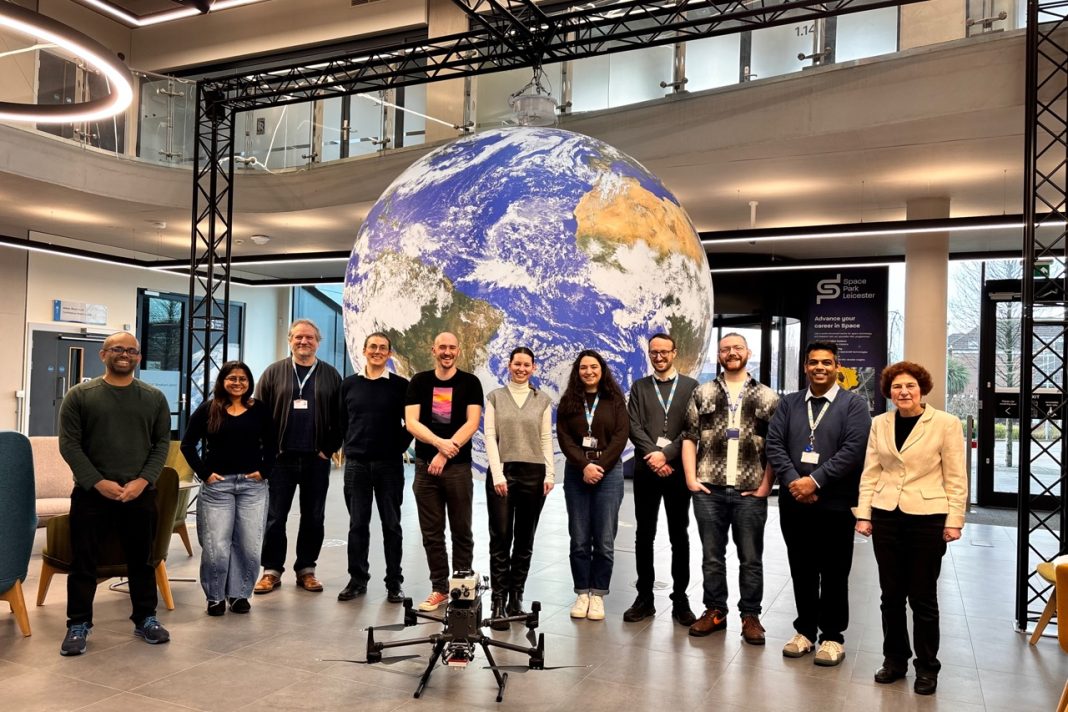

University of Leicester scientists based at Space Park Leicester have established a new service to support businesses in developing artificial intelligence for space uses cost-effectively.
With support of over £680,000 from the UK Space Agency’s National Space Innovation Programme (NSIP), an interdisciplinary team has launched REALM: Rapid information extraction for environmental remote sensing on board spacecraft through Application of Light Machine Learning models in payload computing systems. This new end-to-end, space-optimised machine learning service is designed to accelerate the adoption of Artificial Intelligence (AI) in space missions.
Led by Professor Tanya Vladimirova, a leading expert in machine learning for space systems, as Principal Investigator with Piyal Samara-Ratna, Dr Joshua Vande Hey and Oliver Blake as Co-Investigators, REALM delivers a complete pipeline from algorithm design to in-space deployment.
REALM addresses one of the space sector’s most pressing challenges: how to develop, train, validate, and deploy high-performance machine learning systems that operate reliably within the strict constraints of space environments. By combining advanced algorithm optimisation, innovative training data generation, and low-cost demonstration capabilities, REALM significantly reduces cost, risk, and time-to-deployment for space-based AI.
Through UK Space Agency funding, REALM capabilities have already been successfully applied to traffic monitoring and early wildfire detection, demonstrating real-world impact across Earth observation and environmental monitoring use cases.
Professor Tanya Vladimirova from the University of Leicester School of Computing and Mathematical Sciences said: “The project has clearly demonstrated that high-performing Convolutional Neural Network models can be substantially reduced in size using the innovative Sparse-Split-Parallelism design framework, without compromising performance. By significantly decreasing model size while maintaining high accuracy, the resulting lightweight architectures improve the feasibility of deploying deep learning solutions in resource-constrained space environments, enabling more efficient and autonomous real-time satellite-based data analysis.”
Iain Hughes, Head of the National Space Innovation programme at the UK Space Agency, said: “REALM is an excellent example of how UK expertise is pushing the boundaries of what’s possible in space. By making artificial intelligence more accessible and cost-effective for space missions, the team at Space Park Leicester is helping to ensure British innovation remains at the forefront of the global space sector. This work has real potential to transform how we monitor our planet and respond to environmental challenges, from tracking traffic to detecting wildfires before they spread.”
Among its end-to-end capabilities, REALM develops custom Convolutional Neural Networks (CNNs) based algorithms and applies novel optimisation techniques that reduce the impact on memory usage, compute cost, and execution time by over 50% without impacting performance, enabling efficient on-board execution.
REALM employs large-scale, robust training datasets using a diverse range of sources, including Earth Observation datasets; custom drone and aircraft data capture in visible, multi/hyperspectral, LiDAR and Infra-red formats; and large volumes of scientifically accurate synthetic data for multi-spectral Earth Observation data using a special collaboration with atmospheric chemistry experts GRASP and in-space servicing, assembly and manufacturing (ISAM).
REALM provides expertise to critically assess and optimise algorithm performance to maximise mission value and return on investment. The in-house drone lab utilises an array of off the shelf and custom platforms, which can be equipped with bespoke on-board GPUs supporting the validation of algorithm performance in real-time, at a fraction of the cost of spaceflight demonstrations, with aircraft demonstrations also possible. The team are also developing a novel space-optimised GPU designed to interface with a wide range of payloads with the first in-space demonstration scheduled for Q3 2026. They also have the expertise to support in-space operations.
Find out more about the service: space-park.co.uk/services/machine-learning-ai/