



In the dynamic landscape of technology, one paradigm shift is poised to redefine how we perceive computing and sensing: Neuromorphic Sensing and Computing.
According to the latest report from Yole Group, titled “Neuromorphic Computing, Memory and Sensing 2024,” this growing field is not just a buzzword; it’s a multi-billion-dollar market expected to generate $8.4 billion by 2034.
The projections are staggering. By 2029, the neuromorphic sensing market could swell to $410 million, catapulting to $2.9 billion by 2034. Similarly, the neuromorphic computing market is forecasted to grow from $412 million in 2029 to an impressive $5.4 billion by 2034.
While the concept of neuromorphic computing has been widely discussed for quite some time, neuromorphic sensing (a sensing technology that imitates the behavior of the biological nervous system) is a somewhat less common notion, well-known primarily to specialists, undoubtedly including analysts from the Yole Group.
The unique feature of neuromorphic sensors is their ability to send only essential data for processing rather than all data. This can be achieved in various ways, mimicking biological sensing differently. POLYN offers a straightforward method to add intelligence to any sensor by utilizing the application-specific NASP front-end chip immediately after the sensor.
Drivers Behind the Expected Exponential Growth
In the coming years, the landscape of neuromorphic sensing and computing applications will be diverse yet interconnected. Mobile applications are anticipated to lead the charge in neuromorphic sensing, closely followed by entertainment, smart city infrastructure, automotive, and home applications. Conversely, data center applications will emerge as the primary revenue generators in neuromorphic computing, trailed by automotive, entertainment, smart city, and mobile applications. This diverse range of applications underscores the potential impact of neuromorphic sensing and computing across various industries.
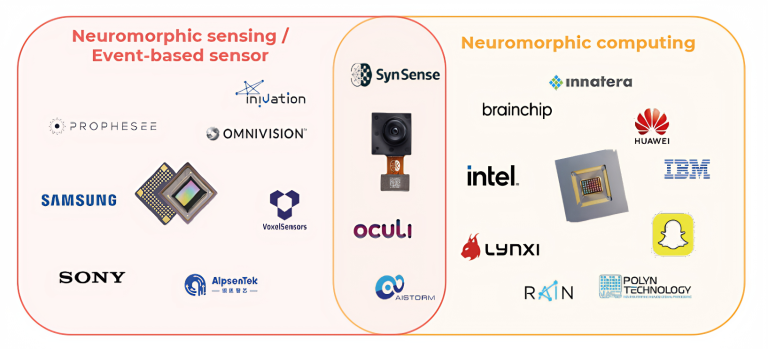
The report discusses an important factor for the industry’s future growth – forming a vibrant ecosystem teeming with activity. Partnerships between traditional and neuromorphic processor firms enhance technological innovation, fueling product offerings.
Established tech titans such as IBM, Intel, Sony, and Samsung strategically target specific markets, while startups explore many approaches. Some neuromorphic companies, including POLYN, target extreme-edge AI on battery-powered devices, while others focus on high-performance computing for data centers. POLYN is proud to be in the company of these industry giants.
Technological Foundations: Low Latency and Power Efficiency
At the heart of the neuromorphic revolution lie its foundational principles: low latency and power efficiency capabilities. As the economic feasibility of scaling semiconductor devices becomes increasingly challenging, neuromorphic technologies offer a beacon of hope. Inspired by the intricacies of the biological nervous system, these solutions provide power-efficient alternatives for AI tasks. Event-driven processing and sparse neural network implementations enable real-time edge AI applications, catering to privacy concerns.
Challenges and Opportunities
Amid the promises, challenges persist. While digital IC designs utilizing distributed SRAM dominate the memory landscape, emerging non-volatile memory technologies show immense potential but are still in the nascent stages of development. Analog in-memory computing, while promising, faces technical hurdles that must be surmounted.
POLYN’s analog approach is free of these limitations related to accessing memory and is set to shape the future of edge AI.
In conclusion, the trajectory of neuromorphic sensing and computing is remarkable. Neuromorphic technologies hold the key to sustainable and efficient edge AI processing, ushering in a new era of technological prowess and innovation.
To learn more, visit www.polyn.ai.


