



Thatcham Research is today revealing further insights from its Trust in Automation study – which polled 2,000 motorists in the US and 2,000 in the UK – and found a significant disconnect between attitudes and behaviours on either side of the Atlantic.
American drivers are more likely to a see a benefit to self-driving or autonomous technology than British drivers: 81% versus 73% respectively. However, American and British drivers were aligned in seeing accident reduction through the removal of human error (21%) as the greatest potential benefit.
It follows therefore that American drivers are more enthusiastic for the imminent introduction of cars with limited self-driving technology like Automated Lane Keeping Systems (ALKS); 11% stated they would buy a car with self-driving capability as soon as possible versus just 4% in the UK.
Asking drivers what they would miss most about driving a manually operated car also uncovered some fascinating contrasts in driving behaviours. Although the drivers surveyed were largely in agreement about missing being in control themselves (US 62% and UK 64%), 17% of American motorists said they would miss being able to drive aggressively when they felt it was necessary versus just 6% in the UK, while 19% in the US said they would miss bending the rules of the road compared with only 9% in the UK.

Matthew Avery, chief strategic research officer, Thatcham Research comments: “This is an intriguing challenge for system developers. We know that brands are designing Automated systems to follow local human driving patterns, making the car’s driving style more or less assertive as relevant.”
Although US drivers appear to be more open to Automation, they are also far more likely to be convinced that current technology can provide a fully autonomous driving experience. 72% in the US versus 52% in the UK think that it’s possible to buy a car today that can drive completely autonomously, as safely as a competent human driver would.
Avery comments: “Could this be the Autopilot effect at play? The claims made by big brands offering ‘full self-driving’ packages have clearly been taken on board by American drivers.”
When asked how they felt about taking back control from the first cars with self-driving capability like ALKS, just under half (48%) of American motorists said they were comfortable with the idea of an emergency handover request from the system. In the UK this number drops to 32%.
Digital divide: taking back control spooking older drivers
The Trust in Automation study has also identified a ‘digital divide’ appearing between younger and older UK drivers.
68% of UK drivers aged 55 or over said they would be uncomfortable at the prospect of resuming control from the system, a figure that decreases incrementally through the age groups, to just 28% of 17–24-year-olds.
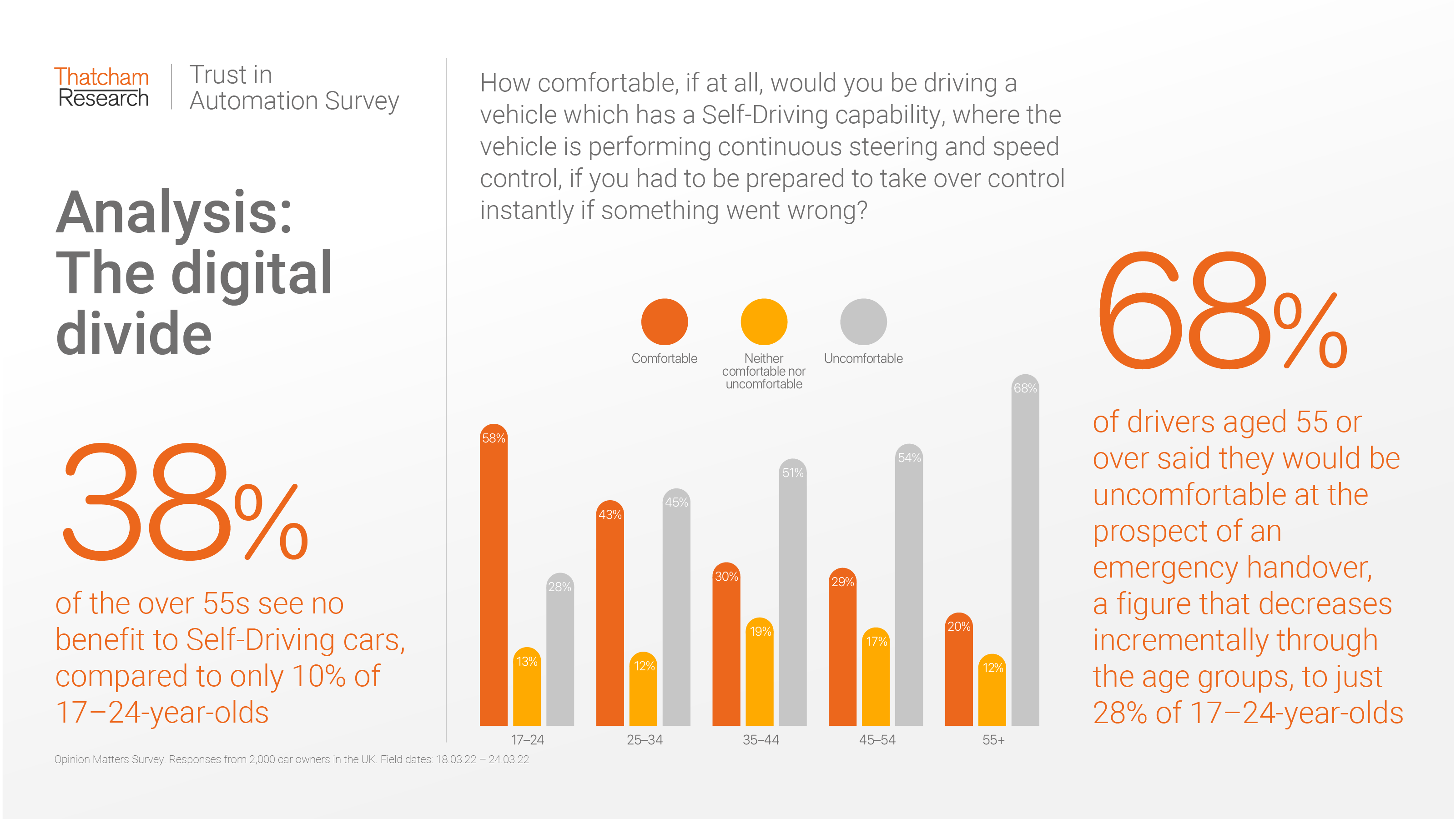
Older age groups were also found to be the most sceptical of Automation in general, with 38% of the over 55s seeing no benefit to self-driving cars, compared to only 10% of 17–24-year-olds.
Avery comments, “Despite the discomfort expressed by drivers, they will have to be prepared to resume control from the system. As such it’s fundamental that self-driving systems communicate clearly with drivers and that those drivers are wholly aware of their responsibilities.
“Without that clarity of communication – from naming conventions to how the system informs motorists that the self-driving mode is engaged – the industry could miss a huge opportunity to commence our journey towards Automation on the safest possible foundations.
“Offering reassurance to more experienced drivers is key, since the first vehicles with self-driving capability are more likely to be out of the financial reach of younger age groups.”


