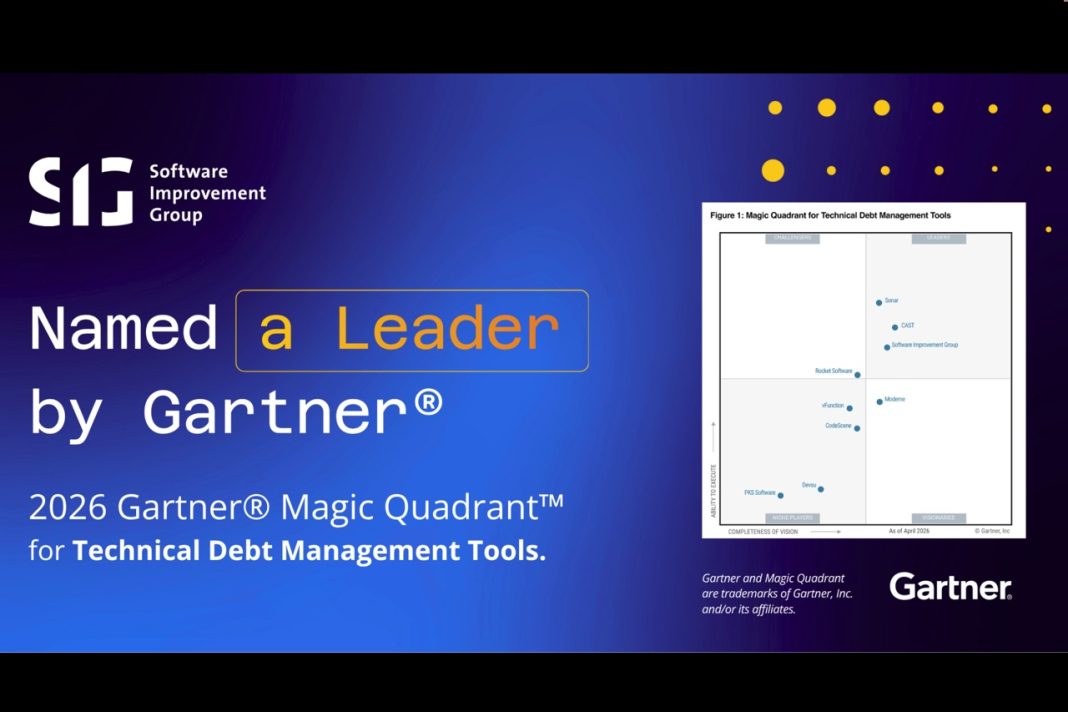

Software Improvement Group (SIG), the global software consultancy behind the Sigrid® software portfolio governance platform, today announced it has been recognized as a Leader in the 2026 Gartner Magic Quadrant™ for Technical Debt Management Tools.
The Gartner report highlights the growing importance of technical debt management as organizations accelerate software delivery through AI coding assistants and agentic AI.
“We believe this Gartner recognition reflects a major shift in software engineering,” said Luc Brandts, CEO of Software Improvement Group. “Technical debt management has evolved from a niche engineering concern into a strategic business priority. As AI accelerates software creation, organizations need visibility into architectural drift, maintainability, security risks, and long-term software sustainability more than ever before.”
The Gartner Magic Quadrant for Technical Debt Management Tools notes that the technical debt management market reflects a consolidation of technologies across static and dynamic analysis, software composition, architecture observability to streamline the remediation process. While AI code assistants are increasingly effective at remediating code-level debt, the market is shifting toward managing architectural technical debt — debt that cuts across multiple systems or architecture layers, which is expected to account for 80% of all technical debt by 2027.
We believe what makes Software Improvement Group unique in this market is that architectural debt governance is designed in from the start, not patched in later.
Architectural debt is distinct from code-level issues. It manifests in the relationships between systems: how components are linked, how teams depend on each other’s work, and whether the software structure still aligns with its original design intent. AI coding tools compound this problem; they operate within a bounded context window, lack domain knowledge of the broader system, and can fill architectural gaps independently.
With 25 years of experience analyzing billions of lines of code, we feel that portfolio-wide visibility is the only reliable way to detect, prioritize, and govern architectural debt before it destabilizes the systems your business depends on. Learn more about SIG’s technical debt management approach.
That same principle extends to how AI-generated code enters your portfolio. Productivity gains from AI coding assistants are real, but so are the risks around quality, security, and legal exposure when that code is deployed without oversight. SIG’s AI code governance capability gives organizations the visibility and guardrails to move faster without losing control.