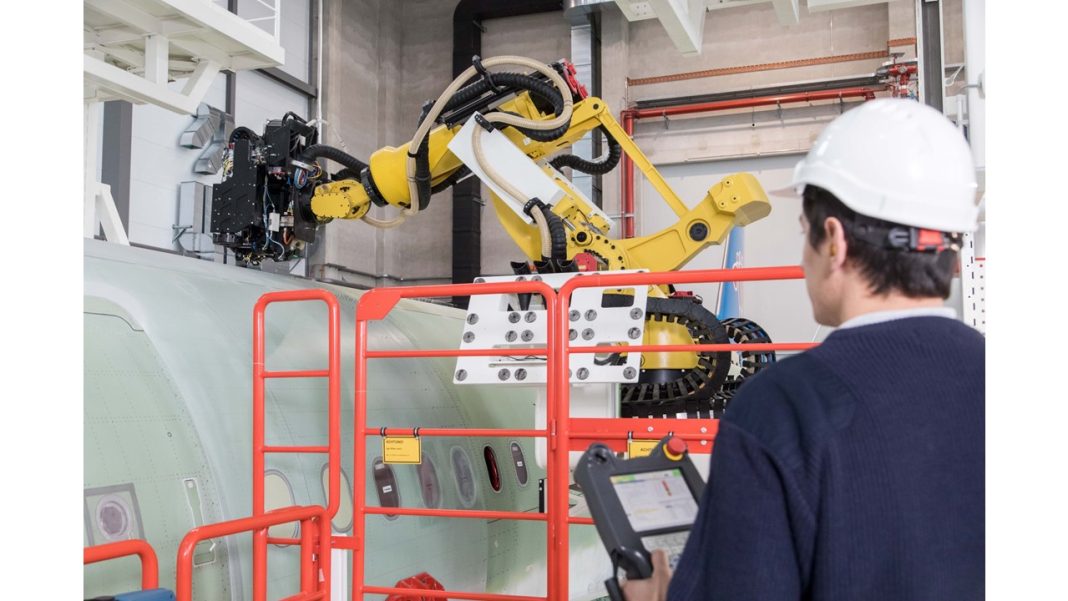

In the face of unprecedented demand for new aircraft, robotics specialist FANUC is helping the aerospace industry to increase production efficiency and boost output. Over the past five years, FANUC has supported Airbus with its in-house robotics strategy, culminating in Airbus developing a robotic drilling system which employs a FANUC M-800iA/60 six-axis robot. The system has improved drilling accuracy and increased productivity for Airbus, while freeing up human employees to work on more creative and value-added tasks.
Breaking the order backlog
The start of this year (Q1 2024) saw the global aircraft order backlog hit record-breaking heights, reaching 15,812. Automation and robotics are considered key levers to support this increasing demand. FANUC has long championed the use of its industrial robotic solutions as a way for aerospace manufacturers to boost production rates, streamline their operations and cut cycle times.
“Automation has become crucial in closing the gap on the backlog in aircraft orders as it significantly enhances production efficiency, reducing the time needed for manufacturing complex components,” says Oliver Selby, Head of Sales for FANUC UK. “Additionally, automation minimises human error and allows for more consistent quality control, ensuring faster turnaround times and enabling manufacturers to meet demand more effectively.”
Automating drilling tasks
Boasting advanced automation technology and an experienced team of robotics experts, FANUC was the ideal company to support Airbus in the development of its in-house robotics division. With its multiple drilling applications still largely completed manually, automating this process was a priority – but sourcing a robot that was robust enough to meet Airbus’ requirements initially proved a challenge.
“The specific solution that Airbus was looking for did not exist anywhere in the market,” explains Oliver. “The robot in question needed to be extremely rigid and stiff but also highly accurate, and with a minimum 60kg payload. We therefore worked together with Airbus to develop a prototype and refined this until it precisely matched their specifications for lower payload/small hole drilling.”
From prototype to production
This prototype has gone on to become the M-800iA/60 six-axis model, which is now part of FANUC’s standard industrial robot range. Also suitable for laser cutting, welding or other applications which require extremely high levels of accuracy, it offers outstanding precision without slowing down the production process.
Following rigorous testing and validation with FANUC, Airbus placed the first commercial order for the M800iA/60. The robot is now part of Airbus’ proprietary automated mobile drilling system. This system has now gone into production and represents the first of a new generation of robotic solutions for Airbus that have been custom designed by its in-house experts, with technical support provided by FANUC. Now on its way to being integrated into the A320 Family pre-assembly line, it adds value to Airbus’ manufacturing processes by reducing costs and stoppages, all while improving quality and saving time.
Reaping the rewards of robotics
Since the introduction of the M800iA/60 to the market, FANUC and Airbus have further developed the technology and implemented it into larger robots in the high accuracy/high stiffness range – 190kg and 270kg payload versions are now available, with a reach of 2m and 2.7m respectively. These additional FANUC robots could allow for further adoption in other applications within Airbus as they move to higher rate production to meet increasing global demand.
“There are numerous benefits to aerospace manufacturers of automating their drilling applications with the M800iA/60, including improved accuracy and repeatability, increased output, and better use of personnel for more value-added tasks,” states Oliver. “Longer term, the development of an in-house robotics division should also enhance the industry’s ability to attract high-level talent to technology-driven, innovative and future-ready companies.”
The future of aerospace manufacturing
Oliver continues: “From FANUC’s perspective, working with Airbus has been an extremely positive and rewarding experience. Showcasing the benefits of automation and robotics to the aerospace industry is vital in helping the sector to reduce the current backlog. This project demonstrates how important it is to collaborate with a robotics partner that will provide the right experience, knowledge, training and technology to support companies to achieve their commercial aims. We hope this will be the first of many such collaborations between FANUC and Airbus to increase efficiency within their manufacturing applications.”
To learn more about the future of aerospace manufacturing, visit FANUC on stand 4900 at the Farnborough International Airshow, 22-26 July 2024.