
Laser cutting is the fastest and most economical separation process, albeit one with the highest investment costs. Particularly in laser-based processes, purchasing used equipment is worthwhile as lasers have a long lifespan with proper maintenance.
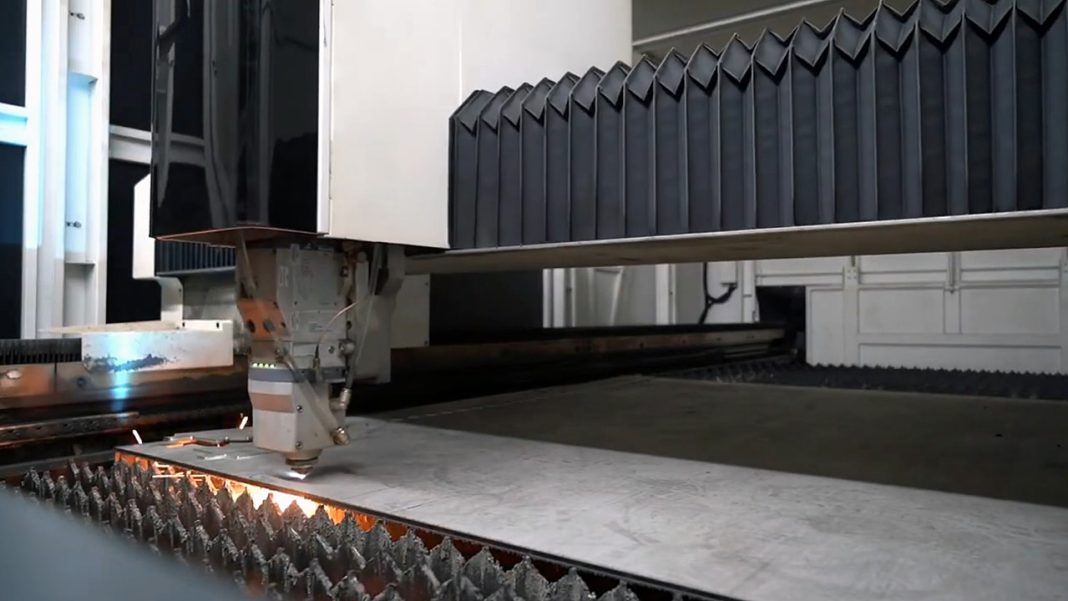
Laser cutting is a separation process where a laser cuts through the material. The laser’s mobility allows complex shapes to be cut precisely and efficiently. Depending on the laser parameters (wavelength, average power, pulse energy, and pulse duration), almost any material can be cut. Especially for sheet thicknesses of 1 to 10 mm, laser cutting is the fastest and most economical separation process.
Advantages of laser cutting
Speed and efficiency: Laser cutting enables fast and precise cuts, even for complex shapes. Cutting speeds of up to 250 m/min are possible depending on the material and application. The ability to process multiple jobs in one operation further shortens production time.
High precision: Laser cutting achieves positioning accuracies of up to ±0.1 mm and repeatability accuracies of ±0.05 mm. The high cutting quality and clean, burr-free edges result from the precision and control of the laser beam.
Automation: Laser cutting systems can be ideally integrated into automated production processes. Automatic loading and unloading of the machine reduce manual labour and minimise errors.
Technical fundamentals of laser cutting
Various laser beam sources are used in industry, including the tried-and-tested CO2 laser and specialised solid-state lasers such as Nd:YAG lasers, fibre lasers or disc lasers. The laser beam is directed onto the focusing optics via mirrors (for CO2 lasers) or fibre optics (for solid-state lasers). There it is concentrated and focused to the desired power density.
The high energy of the laser beam melts, burns, or vaporises the material, completely separating it. The high energy density of the laser beam enables fast and clean cutting by melting or vaporizing the material. An accompanying process gas removes the ablated material from the kerf and protects the optics from fumes and splashes. As a non-contact process, it reduces the risk of workpiece damage.
Used machines as a wise investment
The biggest drawback of laser systems is the high initial investment. However, used machines are significantly cheaper. As laser systems are low-maintenance and have a long lifespan, this investment can be worthwhile.
One of the platforms where used laser cutting systems are traded is the online auction house Surplex. An auction featuring nine used laser cutting machines will end on 11/07. The machines are located at various sites in the Netherlands, Belgium, and Sweden. In detail:
- AMADA: LC2415A 5NT with loading and unloading system, LC-2415 α III, and LC2415A3
- BODOR: P3015, P6020, and T230-A
- PRIMA POWER GENIUS 4020
- TRUMPF Trumatic L 2530
- BYSTRONIC BySpeed 3015 (without minimum price)
To learn more, visit www.surplex.com.