

When machine builders talk about the benefits of cabinet-free automation, the conversation usually focuses on faster installation and simplified maintenance. What often goes unnoticed is a commercial advantage that starts well before a machine even reaches the factory floor: shipping costs. In a logistics environment increasingly shaped by volumetric pricing models, machine footprint is becoming just as important as machine weight. Here Neil March, MX Product Specialist at Beckhoff, explains how this shift makes control architecture a surprisingly relevant cost driver.
Why shipping cost is no longer just about weight
Most global carriers calculate freight charges using chargeable weight, which is based on either actual mass or volumetric weight depending on which is greater. In practice, this means bulky but relatively light industrial equipment is often penalised simply for occupying space.
For OEMs shipping large automation systems, compact machine design becomes a direct commercial factor and not just an engineering preference.
The cabinet problem
A traditional control cabinet is not a lightweight proposition. Steel enclosures, cable ducts, DIN rails, terminal blocks, contactors and the associated wiring infrastructure add significant mass to a machine. For large-scale systems, a single cabinet can weigh well over 100kg before installation. When multiple cabinets are required, which is often the case in packaging and intralogistics, the shipping cost grows quickly.
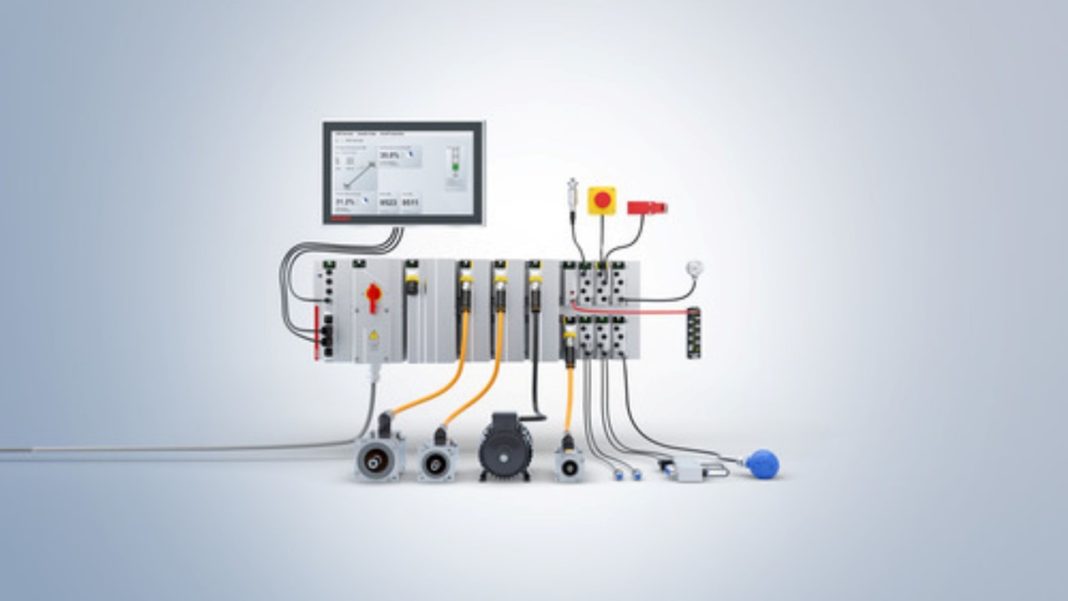
Cabinet-free automation changes that equation entirely. For example, the Beckhoff MX-System replaces the traditional control cabinet with modular IP67-rated function modules mounted directly onto the machine structure. By eliminating the enclosure itself and reducing internal wiring requirements, the system significantly lowers overall machine weight and shipping volume.
This approach has been demonstrated in a real-world project with machine builder Nordfels for TIGER Coatings, where the MX-System was deployed in a hybrid architecture for an automated box sealer in a space-constrained, brownfield environment. By decentralising drive control and 48 V power supply directly into the machine structure, Nordfels reduced the remaining control cabinet to less than half its original volume compared to a conventional design while meeting functional requirements of the system.
Fewer components, lighter shipments
The Nordfels project illustrates a broader structural advantage. When control functionality is distributed rather than centralised, the physical infrastructure required to support it is reduced at source. Less steel, copper, and fewer mounting systems.
The result is a lower transport footprint and improved packing efficiency. For machine builders operating across international supply chains or deploying modular systems between production sites, this creates a tangible logistical advantage and reduced the cost of oversized shipments.
Logistics simplified across the supply chain
Removing the control cabinet also streamlines logistics beyond the machine itself. There is no longer a separate enclosure to manufacture, package and ship independently, which reduces packaging complexity and removes the need for specialist freight arrangements.
The MX-System’s robust aluminium baseplate and machine-mounted modules are specifically designed for industrial transport conditions, enabling automation hardware to be integrated directly into the machine rather than shipped as a separate subsystem. This supports a more consolidated delivery model, where fewer standalone components require coordination across manufacturing and logistics stages.
The operational efficiencies continue at the destination site. Data shows that assembly and testing time can fall from at least 24 hours to approximately one hour using the MX-System’s plug-and-play architecture. This reduces on-site engineering effort and commissioning times.
A strategic advantage for machine builders
As dimensional pricing and logistics cost volatility remain persistent factors in global supply chains, compact machine architectures offer a clear operational advantage. Reduced transport footprint, simplified logistics processes and lower installation complexity all contribute to a more efficient end-to-end machine lifecycle.
For OEMs in competitive markets, those efficiencies translate into stronger delivery performance and smoother project execution, particularly across international production networks.
Cabinet-free automation is ultimately not just about removing the cabinet itself, but rethinking how machines are designed, assembled, transported and commissioned. As that thinking matures, the logistics case is likely to become as compelling as the engineering one.
To learn more about cabinet-free automation, visit: www.beckhoff.com/en-gb/products/mx-system.