
Skoltech scientists have presented a model that facilitates the design and operation of vanadium redox flow batteries. These are large-scale storage units for electrical power that promise to play a major part in the energy transformation and are already used by utilities in China, Germany, and the U.S. to even out peak demand on the energy grid. This technology — or a similar solution — will be indispensable for the widespread adoption of electrical vehicles and renewable power, as well as boosting the efficiency and security of nuclear power plants and providing adequate backup power to critical infrastructure. The study came out in the Journal of Power Sources.
“Flow batteries are a type of chemical energy storage not fundamentally different from lithium-ion and other batteries. The basic components are the same: two electrodes and a medium, called the electrolyte, that facilitates the transfer of ions. But rather than on the electrodes, the chemical reaction providing energy occurs in the liquid electrolyte,” said the paper’s lead author, Senior Research Scientist Mikhail Pugach from Skoltech Energy.
“From a practical standpoint, flow batteries are much bulkier and heavier than conventional accumulators, so they are not suitable for portable devices. That said, they offer great capacity, longevity, and adaptability for grid-scale storage. Besides, they can be rapidly recharged, create no fire hazards, and rely on raw materials sourced from Russia. And vanadium is fairly easy to recycle,” the researcher added.
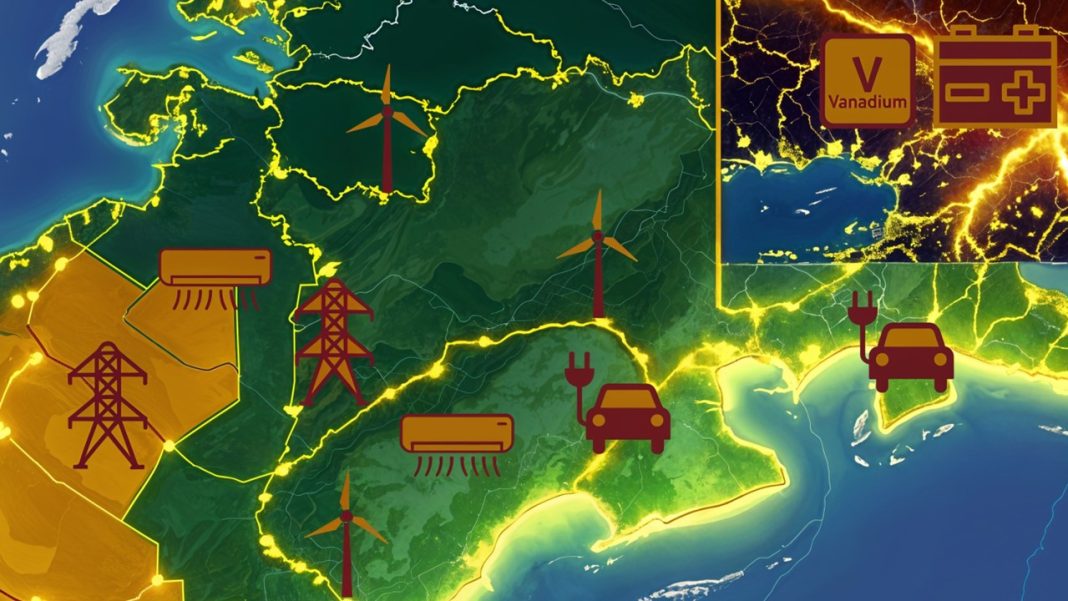
Vanadium flow redox batteries are the most advanced technology employed by utility companies for such large-scale power storage. It allows the energy producers to even out the surges in demand for electricity caused by simultaneous use of air conditioners and the like. While peak load is an ever-present problem, it is likely to aggravate as more drivers opt for electric cars and start plugging them in all at once after the evening commute home. Vanadium batteries also help manage the variable nature of power generation from renewable sources. The technology is well-suited as a backup power source at data centers, nuclear power plants, and other industrial facilities that require uninterrupted operation.
“Unlike lithium-ion batteries, the vanadium-based storage systems can retain nearly undiminished capacity over many cycles of operation. This requires appropriate design to begin with, plus suitable maintenance protocols. And here the model provided in our study does two things. It helps the manufacturer optimize the materials used in the battery to increase reliability and slow down the decline in capacity. It also tells the company servicing the storage system when and how to do it. This involves correcting the imbalances that tend to develop in the electrolyte,” said Research Scientist Sergey Parsegov of Skoltech Energy, who served as the project’s principal investigator.
The model thus makes it possible to leverage the technology’s inherent advantage when it comes to actually implementing vanadium flow batteries.
According to the researchers, the key advantage of their approach is that is does not require much information about the membrane of the modeled battery. Usually, one has to specify the materials and the precise technology used, along with the dimensions. The new model gradually adapts to the battery over the course of its operation, until an appropriate accuracy is achieved.
At the heart of the model is a very detailed description of the underlying physical processes occurring in the device. This is what enables highly accurate predictions with minimum input data. “The physical model goes back to a model my colleagues and I published based on my PhD thesis project at Skoltech,” Pugach said. “What sets the new model apart is that we’ve incorporated uncertainty factors for various membrane parameters. This enables model adaptation to current membrane conditions and eliminates the need for detailed information about the physical properties of the membrane.”
The model accepts some basic parameters and uses a special algorithm to adjust the parameters to the actual values in the energy storage system in the course of a brief experiment.
Previously, Skoltech researchers proposed a way to even out the load on the power grid by scheduling artificial lighting in greenhouses so as to grow lettuce precisely when electricity prices are at their lowest.
The research reported in this story was supported by the Russian Science Foundation under Project 23-29-00807 (https://rscf.ru/en/project/23-29-00807/).