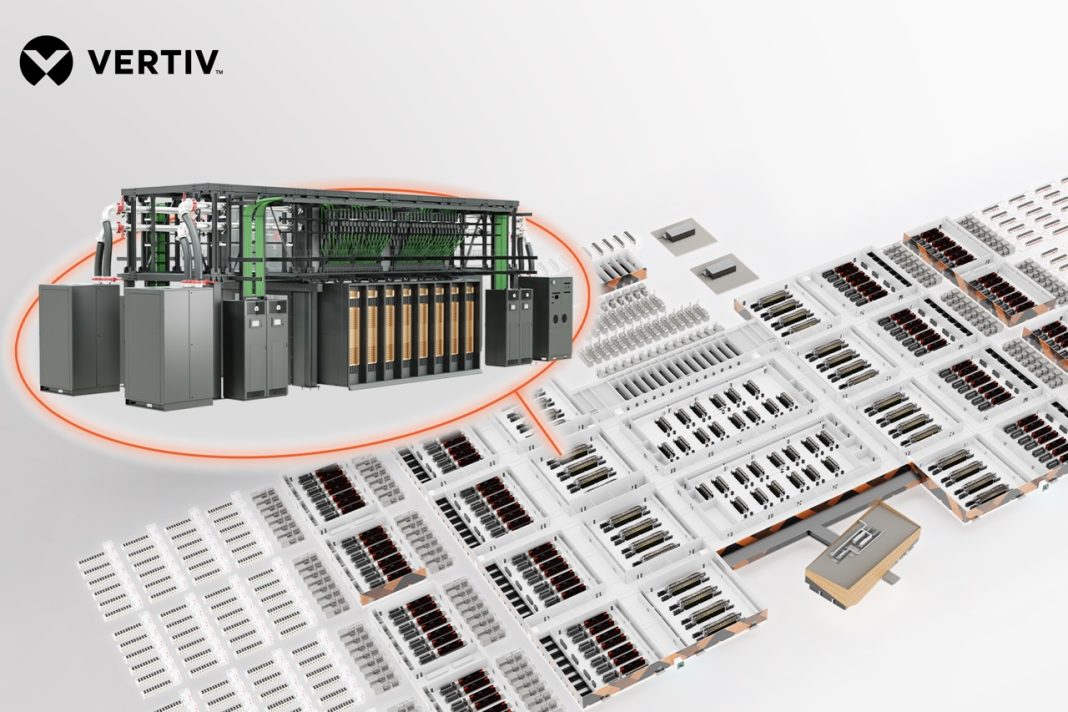

Vertiv (NYSE: VRT), a global leader in critical digital infrastructure, today announced its role in advancing converged physical infrastructure designs for the NVIDIA Vera Rubin DSX AI factory reference design and the NVIDIA Omniverse DSX Blueprint.
As AI factories scale in density, complexity, and power demand, operators are under pressure to compress time to deployment, improve infrastructure utilisation, and reduce integration risk. A new infrastructure design approach that reduces complexity, improves confidence before buildout, and accelerates time to capacity is now available to meet these evolving needs. Through its work with NVIDIA, Vertiv is contributing simulation-ready, or DSX SimReady digital power and cooling assets, validated interfaces, and repeatable infrastructure building blocks designed to help customers deploy AI factories faster and with greater operational assurance.
This work reflects an expansion of Vertiv’s established approach to converged physical infrastructure – a system-level model that integrates power, cooling, controls, and services into interdependent designs optimised across the full power train and thermal chain. This approach is enabled through five foundational elements: repeatable building blocks, defined interfaces, system orchestration, digital continuity, and lifecycle support. Together, these elements support more scalable AI factory execution by helping reduce design complexity, strengthen coordination across infrastructure domains, and improve confidence from initial design through deployment and operation.
At the core of this approach is a scalable building block architecture designed around the standardised 12.5MW infrastructure blocks of Vertiv™ OneCore integrated modular solutions that can be combined, configured, and extended to support deployments ranging from smaller AI clusters to gigawatt-scale AI factories. By establishing repeatable block-level designs with validated interfaces, Vertiv aims to simplify scaling while improving deployment consistency, system coordination, and operational performance.
“AI factories are forcing a fundamental change in how digital infrastructure is designed, validated, and deployed,” said Scott Armul, chief product and technology officer at Vertiv. “Vertiv’s role is to help turn complex AI infrastructure from a collection of separate products into converged, simulation-ready physical systems. Working with NVIDIA, we are helping customers move faster from design to deployment. By combining our power and cooling portfolio with validated interfaces and digital models, we can help customers accelerate development, improve operational confidence, and unlock better output per watt.”
Vertiv’s collaboration supports the development of digitally validated AI factory infrastructure using real-time simulation and system-level modelling before physical deployment begins. This approach is designed to help customers:
- reduce deployment complexity and field integration risk,
- accelerate time to operational readiness,
- improve infrastructure coordination across power, cooling, and controls,
- and optimise performance from grid connection through chip-level thermal management and heat-reuse pathways.
Vertiv’s contribution is grounded in its ability to bring together one of the industry’s most complete portfolios of critical power, thermal management, integrated controls, and lifecycle services into a cohesive converged physical infrastructure. Unlike conventional modular or prefabricated approaches that primarily compress schedule, converged physical infrastructure is intended to deliver both deployment speed and compounding system-level gains. By standardising interfaces and creating repeatable building blocks, Vertiv aims to support more scalable AI factory execution while enabling improved performance, efficiency, and reliability.
“As AI factories scale to unprecedented levels of power and density, enterprises require a converged approach to physical infrastructure that unifies power, cooling, and digital twin simulation to reduce deployment risk,” said Vladimir Troy, vice president of AI Infrastructure at NVIDIA. “By integrating simulation-ready infrastructure models into the NVIDIA Vera Rubin DSX design, Vertiv is providing the repeatable building blocks and validated interfaces necessary to accelerate the path from design to operational readiness.”
This collaborative output, Vertiv™ OneCore Rubin DSX, is a design outcome grounded in converged physical infrastructure that Vertiv will continue to iterate for multiple compute generations ahead. It is intended to support AI factory builders with parameterised infrastructure models and deployment-ready building blocks that span power, cooling, controls, and lifecycle services.
Vertiv expects this work to inform future converged infrastructure offerings across hyperscale, colocation, enterprise, and emerging AI deployment environments.
For more information on Vertiv solutions for AI infrastructure, visit Vertiv.com.