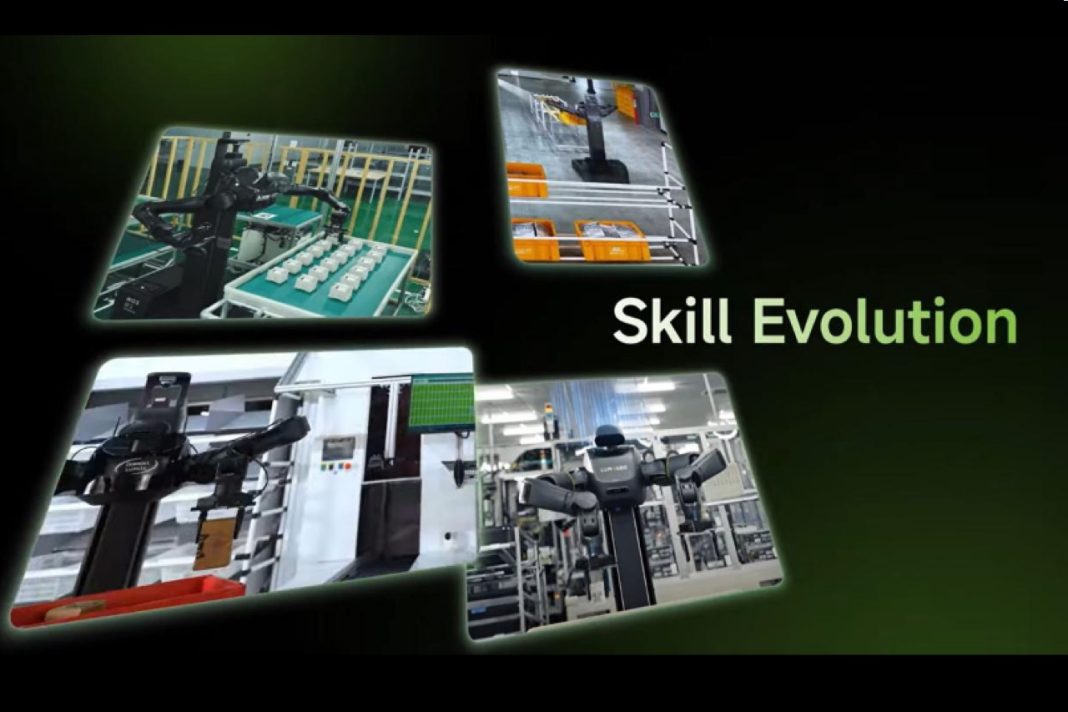

Lumos Robotics today launched Lumos NexCore, a skill evolution engine designed to accelerate the development and deployment of embodied AI for industrial applications.
The platform aims to cut the development time for a new robotic skill from weeks to days, addressing a key barrier to the adoption of embodied AI: the heavy reliance on engineers for programming, data collection, model tuning and on-site debugging.
As factories move beyond highly standardized production, robots are increasingly being asked to handle tasks that vary by product, workpiece and production environment.
Under conventional approaches, each new task or change to a production line can require engineers to collect new data, adjust models and repeatedly debug the robot on site. This makes deploying robots at scale both time-consuming and costly.
NexCore is designed as industrial infrastructure for producing robotic skills at scale, bringing together task definition, data ingestion, model training, skill evaluation, skill management, deployment and continuous learning in a single workflow.
Users can describe tasks in natural language, connect real-world, simulation and video data, train candidate skills, evaluate them and deploy validated capabilities to robots.
Validated skills can also be packaged and reused across compatible robots and similar tasks, allowing experience gained in one production environment to become a reusable asset.
The platform turns a traditionally fragmented, engineering-intensive process into a standardized skill-production pipeline:
Task Definition → Data Ingestion → Model Training →Skill Creation → Evaluation → Deployment → Data Feedback →Continuous Optimization
Validated on Mitsubishi Electric production lines
NexCore’s capabilities have been validated through Lumos Robotics’ ongoing collaboration with Mitsubishi Electric.
The collaboration covers industrial scenarios including quality inspection, assembly, sorting and material handling — and has expanded from PLC inspection to tasks including box pushing, screwdriving and material handling.
Rather than developing skills once and delivering them as fixed capabilities, Lumos continuously trains and optimizes the robots using data generated during production. Through this process, MOS2 robots have achieved success rates of up to 99% across multiple tasks.
MOS2: The execution layer for NexCore skills
The primary physical platform for NexCore-generated skills is MOS2, Lumos Robotics’ second-generation heavy-duty wheeled-arm embodied AI robot designed for industrial environments.
Together, MOS2 and NexCore create a closed-loop system: robots execute skills in real production environments, operational data flows back into NexCore for model training and skill optimization, and improved skills are then redeployed to the robots. This allows skills to evolve through real-world use rather than remaining fixed at the point of deployment.
“The key to scaling embodied AI is making the cost of acquiring a new skill low enough,” said Yu Chao, Founder and CEO of Lumos Robotics. “Our goal is to make robotic skills producible at scale.”
Lumos envisions NexCore as a platform for the embodied AI era, giving factories and developers greater control over creating and continuously improving robotic skills.
“We are building a complete delivery system connecting robot hardware, embodied intelligence, industry-specific skills and real-world industrial scenarios,” Yu said. “NexCore provides the infrastructure for producing and continuously iterating those skills.”
For Lumos Robotics, the ultimate measure of commercialization remains customer value: what tasks a robot can solve, how much value it creates, and whether it can be deployed at a sufficiently low cost.
NexCore is designed to address the capability side of that equation by making robotic skills faster to produce, easier to validate, more efficient to deploy and increasingly reusable.
As experience from real industrial tasks accumulates and proven capabilities are reused across robots and scenarios, Lumos Robotics aims to move embodied AI beyond one-off deployments and toward scalable, continuous skill improvement across industrial environments.