


In industries such as aerospace and energy, the integrity of critical components depends on more than their bulk composition. Whether a material will withstand harsh operating conditions or break down too soon can be determined by chemical nanoscale details. Here, Britta Siefer, EM expert from Thermo Fisher Scientific explains why compositional analysis of superalloys and other advanced materials is increasingly dependent on transmission electron microscopy (TEM).
Superalloys are designed to endure demanding settings like nuclear reactors, gas turbines and jet engines. Carefully crafted microstructures, frequently involving complex phases like γ/γ′ precipitates and intergranular carbides, are responsible for their remarkable strength and resistance to high temperatures. Manufacturers require more than just standard analysis techniques to properly characterise these structures.
Breaking down different methods
Though scanning electron microscopy (SEM) with energy-dispersive X-ray spectroscopy (EDS) is widely used in quality control, it cannot always resolve nanoscale precipitates or segregation layers.
Another popular method, atom probe tomography (APT), provides near-atomic resolution and three-dimensional compositional information. However, it analyses only extremely small needle-shaped specimens, typically tens to hundreds of nanometres in size, and requires complex preparation. This limits its practicality for routine use in industrial workflows.
TEM provides a helpful middle ground. TEM imaging entails transmitting a high-energy electron beam through an ultrathin sample in order to generate contrast from atomic scale changes in composition and structure. This enables imaging of lattice planes, dislocations and nanoscale defects over comparatively larger fields of view than APT and at a resolution far beyond what SEM can achieve.
When combined with EDS and electron energy-loss spectroscopy (EELS), TEM can also map the chemical composition of individual precipitates and grain boundaries. This ability to link structural and chemical information within a single analysis makes TEM a versatile tool for both research and applied quality control.
Compositional mapping in practice
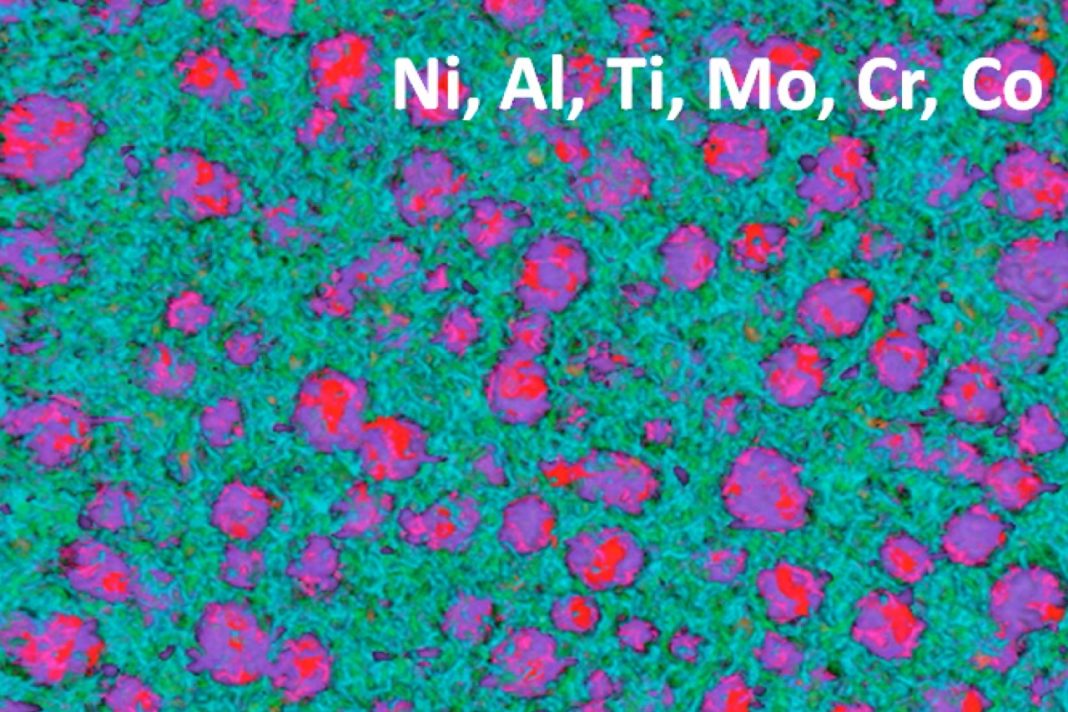
To illustrate the advantages of TEM-based analysis, let’s focus on an example. Researchers recently analysed a nickel-based superalloy sample using the Thermo Scientific Talos Scanning Transmission microscope — a scanning/transmission electron microscope (S/TEM).
Using high-resolution imaging alongside EDS, researchers were able to distinguish the γ matrix from the γ′ precipitates that provide strength at elevated temperatures. In addition, the TEM analysis revealed trace segregation of elements such as titanium and tantalum at grain boundaries.
The Talos (S)TEM recorded the chemistry and structure of these nanoscale features in a single workflow by fusing rapid imaging with accurate compositional mapping.
These results demonstrate the usefulness of TEM in both detecting the existence of phases and measuring their chemical makeup. For instance, the stability of γ′ precipitates under high-temperature service is directly impacted by the concentration of titanium and aluminium in their composition. Likewise, element segregation at grain boundaries may indicate possible locations for corrosion or crack initiation.
TEM gives a complete picture of a material’s actual performance potential by capturing both phase structure and nanoscale chemistry. This is especially helpful when analysing failures. More efficient root-cause analysis and preventive measures are made possible by detecting nanoscale flaws before they develop into larger defects.
Implications for industry
To industries such as aerospace, this level of detail is essential. Before being approved for use in aircraft, jet engine components must meet strict standards like SAE AMS, which demand evidence that the alloy’s microstructure satisfies design requirements.
TEM makes it possible to verify that strengthening precipitates are present in the right proportions and that no harmful segregation has occurred during processing. The ability to identify nanoscale depletion zones means manufacturers can certify materials with greater confidence, reducing the risk of in-service failure.
In the energy sector, turbine blades and other high-stress components must endure years in extreme thermal and chemical environments. TEM-based analysis makes it possible to monitor microstructural evolution over time, supporting life-extension strategies and predictive maintenance. As energy companies push toward greater efficiency and sustainability, these insights aid in maximising the value of components while preserving safety.
Traditional analysis tools are no longer adequate to fully capture the complexity of advanced materials as manufacturing demands rise. With its ability to combine atomic-scale imaging and chemical mapping, TEM is bridging this gap. By making nanoscale compositional variations visible, it provides engineers with the knowledge needed to design, certify and maintain superalloys with confidence. This ultimately ensures that critical components are truly fit for purpose, even in extreme environments.
About Thermo Fisher Scientific
Thermo Fisher Scientific Inc. is the world leader in serving science, with annual revenue over $40 billion. Our Mission is to enable our customers to make the world healthier, cleaner and safer. Whether our customers are accelerating life sciences research, solving complex analytical challenges, increasing productivity in their laboratories, improving patient health through diagnostics or the development and manufacture of life-changing therapies, we are here to support them. Our global team delivers an unrivaled combination of innovative technologies, purchasing convenience and pharmaceutical services through our industry-leading brands, including Thermo Scientific, Applied Biosystems, Invitrogen, Fisher Scientific, Unity Lab Services, Patheon and PPD. For more information, please visit www.thermofisher.com.