


According to latest research by Growth Market Reports, the global Robotics and Automation Actuators market size reached USD 23.4 billion in 2025, reflecting robust expansion driven by increasing automation across diverse industries worldwide. The market is experiencing strong and sustained growth momentum, with a CAGR of 12.9% projected for the period 2026 to 2034. By the end of 2034, the market is forecasted to achieve a valuation of USD 69.8 billion.
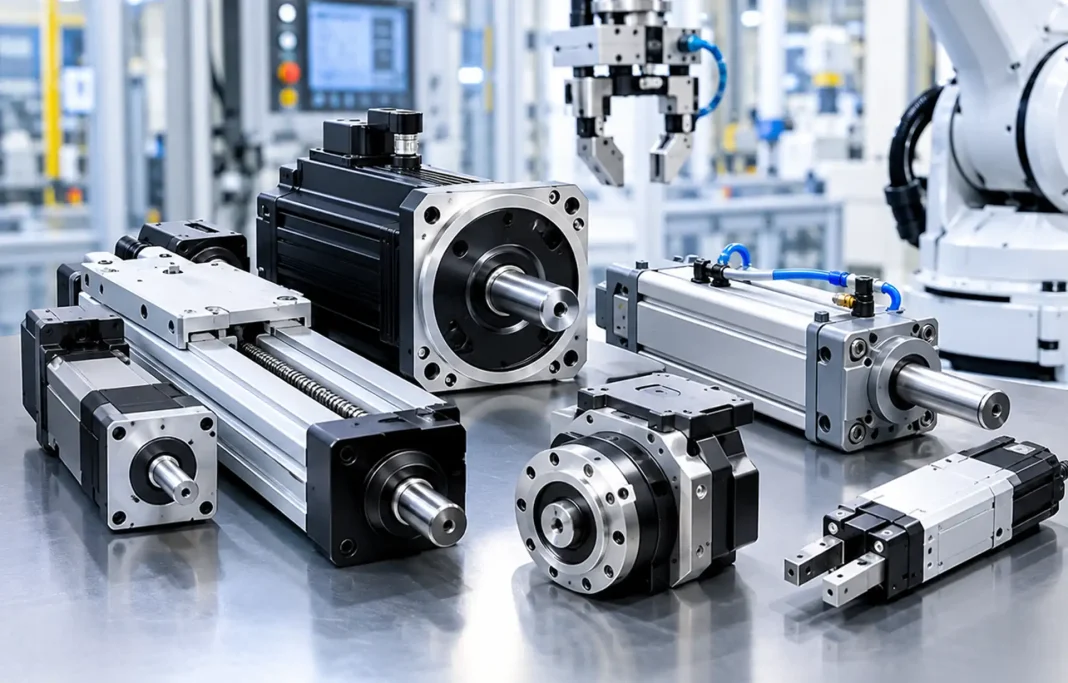
The Robotics and Automation Actuators Market is gaining momentum as industries increasingly adopt automated systems to improve productivity, precision, and operational consistency. Actuators serve as essential components in robotics and industrial machinery by converting electrical, pneumatic, or hydraulic energy into controlled physical movement. Their ability to enable accurate positioning, rotation, gripping, and linear motion makes them fundamental to modern manufacturing and automated operations.
Key Drivers
Rising Adoption of Industrial Robotics
Manufacturers are integrating robotic systems into assembly, material handling, packaging, welding, and inspection processes. These applications require actuators that can deliver repeatable movements, precise control, and dependable performance during continuous operation. As production facilities pursue higher throughput and improved product consistency, advanced actuation technologies are becoming increasingly important to automation infrastructure.
The expansion of collaborative robots and compact robotic platforms is also creating demand for actuators that combine accuracy with efficient space utilization. These components help robotic equipment perform complex movements while supporting flexible production layouts.
Growing Demand for Energy-Efficient Systems
Energy consumption has become an important consideration for industries modernizing their equipment. Electric actuators are attracting attention because they offer controllable movement, straightforward integration with digital systems, and opportunities to optimize power usage. Their suitability for applications requiring accurate speed and position control supports adoption in manufacturing, electronics, and automated laboratory environments.
Technological Advancements in Actuator Design
Integration with Smart Control Systems
Actuator manufacturers are increasingly incorporating sensors, electronic controls, and communication capabilities into motion systems. These features allow equipment to provide operating feedback, monitor movement, and support coordinated control with industrial automation platforms. Improved connectivity can help operators identify performance irregularities and make adjustments before they affect production.
Smart actuation technologies also support predictive maintenance strategies. By monitoring parameters such as temperature, vibration, position, and operating cycles, connected systems can help maintenance teams identify developing problems and plan interventions more effectively.
Improvements in Precision and Compactness
Developments in motor design, materials, transmission mechanisms, and control electronics are helping improve actuator performance. Compact designs are particularly relevant to collaborative robots, medical equipment, semiconductor manufacturing, and other applications where installation space is limited.
Greater precision also supports automated processes that require consistent positioning and carefully controlled force. These capabilities are expanding the potential use of actuators in applications involving delicate components and complex motion sequences.
Market Challenges and Constraints
High Initial Investment and Integration Complexity
Advanced actuator systems may require substantial investment in hardware, controllers, software, installation, and maintenance. Integrating different actuator types into existing machinery can also create engineering challenges, particularly when equipment uses incompatible communication protocols or outdated control architectures. These considerations may slow adoption among smaller manufacturers operating with limited capital budgets.
Reliability and Maintenance Requirements
Actuators used in demanding industrial environments must withstand repetitive movement, mechanical loads, temperature fluctuations, and exposure to dust or moisture. Wear in bearings, seals, gears, and other components can affect operating accuracy and service life. Manufacturers must therefore balance performance requirements with durability, maintenance accessibility, and total ownership costs.
Emerging Opportunities Across Industries
Expanding Applications Beyond Manufacturing
Although industrial manufacturing remains an important application area, opportunities are developing in healthcare, logistics, agriculture, aerospace, and infrastructure management. Automated warehouses use actuators in sorting equipment and robotic handling systems, while healthcare applications may require precise movement in diagnostic instruments and assistive devices.
Agricultural automation is another emerging area, with robotic equipment increasingly used for controlled handling, planting, and harvesting operations. These diverse applications are encouraging demand for specialized actuation solutions designed around specific operating conditions.
Customization and Modular Automation
The shift toward modular production systems creates opportunities for actuator suppliers to develop adaptable components that can be configured for different machines and applications. Standardized interfaces, flexible control options, and simplified installation can help manufacturers upgrade production lines without replacing entire systems.
Competitive Landscape
Rockwell Automation
ABB Ltd.
Siemens AG
Schneider Electric SE
Emerson Electric Co.
Festo SE & Co. KG
SMC Corporation
Parker Hannifin Corporation
Bosch Rexroth AG
Mitsubishi Electric Corporation
Kollmorgen Corporation
Future Outlook
The future of the Robotics and Automation Actuators Market is expected to be shaped by continued advancements in industrial robotics, artificial intelligence, smart manufacturing, and precision motion control. Increasing adoption of collaborative robots, autonomous systems, and automated production lines is likely to create new opportunities for electric, pneumatic, and hydraulic actuator technologies. Integration with intelligent sensors, real-time monitoring, and predictive maintenance solutions may further improve operational efficiency, reliability, and equipment lifespan.
Additionally, growing automation across healthcare, logistics, agriculture, electronics, and aerospace is expected to expand application areas. As industries prioritize energy efficiency, flexible manufacturing, and reduced operational downtime, demand for compact, connected, and high-performance actuators is anticipated to strengthen, supporting long-term market development.