

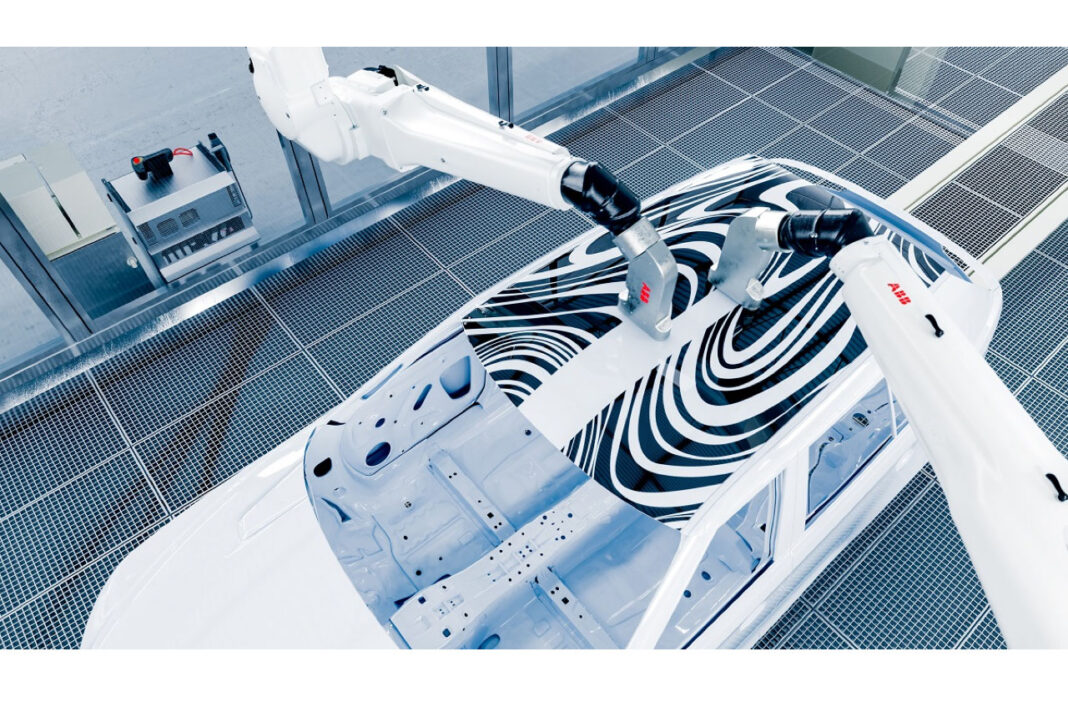

ABB’s PixelPaint robotic non-overspray technology for the automotive industry has won this year’s Innovation and Entrepreneurship in Robotics & Automation (IERA) Award for Outstanding Achievements in Commercializing Innovative Robot and Automation Technology.
Launched in 2020, PixelPaint uses inkjet head technology to directly apply high resolution two-tone or individualized designs to a car body in a single pass, enabling manufacturers to easily meet the rising demand for customized paint jobs while eliminating wasteful overspray.

“We are delighted that our PixelPaint solution has been recognized for its innovative, sustainable technology that helps our customers respond to consumer requests for more personalized design. With PixelPaint, 100 percent of the paint can now be applied in half the time compared to the previous method used for custom paint jobs, with a much better finish quality,” said Joerg Reger, Managing Director of ABB Robotics Auto OEM Business Line. “For our customers, this provides the triple bonus of saving millions of dollars per year through reduced paint consumption, improved efficiency and improved environmental performance through reduced VOC and CO2 emissions, while meeting their customer needs.”
Traditionally, applying a two-tone or customized design onto bodywork has required a vehicle to be put through a painting line twice, once for the first layer and then, after the areas have been masked, again for the second color. Typically, masking the bodywork has needed around 10 to 20 operators per shift, with two operators also needed to de-mask it after the second color had been applied.
With only 70 to 80 percent of the paint being applied to the bodywork surface when sprayed, wastage levels have been significant, increasing costs through recycling and having to purchase additional paint.
PixelPaint overcomes these issues, providing a faster, highly accurate and more sustainable solution for customized painting. The PixelPaint cell comprises a high DPI inkjet head, two IRB 5500 paint robots, dosing control package, and RobotStudio® programming software for two tone and decorative painting applications.
The ability to combine improved efficiency, flexibility and environmental performance was a key factor in the jury’s decision to bestow the award to PixelPaint.
“The jury is pleased to honor ABB’s PixelPaint technology, with the 17th IERA Award,” said Jury Chair Rob Ambrose. “The innovative solution for automated car painting combines more flexibility and customization with reduced wasted paint for the wellness of the environment.”
The IERA Award highlights and honors the achievements of innovators with value creating ideas and entrepreneurs who propel those ideas into world-class products. The IEEE Robotics and Automation Society (IEEE/RAS) and the IFR jointly sponsor the award – underlining their determination to promote stronger collaboration between science and industry in robotics.


