
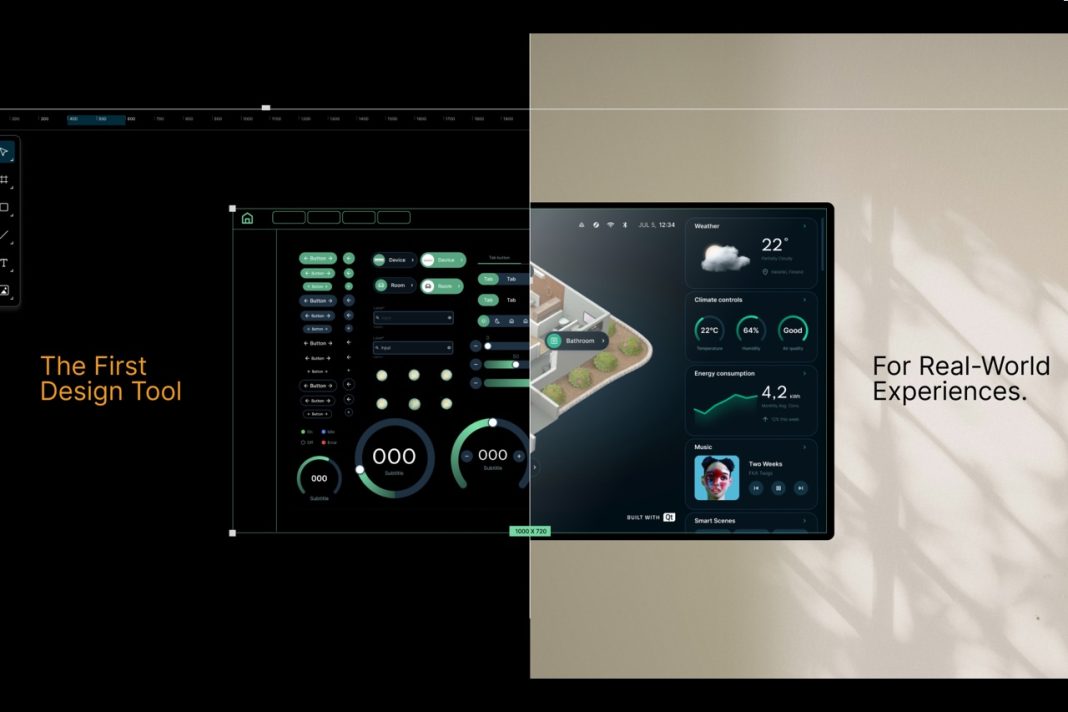


Today at Qt World Summit 2026, Qt Group (Nasdaq Helsinki: QTCOM) has announced Clate, a purpose-built design tool for designers creating real-world embedded user interfaces. It is built to remove the need to rely on generic web and mobile design tools and give embedded UI/UX designers a no-code, AI-native environment, allowing designers to own the complete user experience, even on resource-constrained hardware.
The widespread adoption of smartphones has raised users’ expectations of how an interface should look and feel, and embedded devices are no exception. But designing for an embedded device is fundamentally different due to the severe resource limits present on the target hardware. So far, incumbent design tools have failed to recognize this nuance. Most are built for web and mobile, and the UI they produce simply won’t perform on real-world devices. While niche tools for embedded UX design do exist, these lean so heavily on code editing that designers are pushed out of the process. In these workflows, UI and UX designs are routinely compromised, as both design and development teams struggle to optimize for complex target hardware.
This is especially crucial for designers working on industrial automation interfaces that will be used in extreme environments where poor lighting, dust, and constant vibrations can impede machine use. If any small element of these interface designs is lost or altered as a developer converts it into code, the usability of these machines can suffer drastically. Even a simple touch screen interface for this environment is meticulously designed, with buttons carefully spaced and sized to account for use while wearing protective equipment such as heavy-duty gloves, and high-contrast themes composed precisely to maximize visibility. And this is all mapped out to minimize the cognitive load and prevent operator fatigue from accumulating during long shifts. But while the designs are thoughtfully composed, the end-user experience can be vastly different once the design has been converted into production-ready code, creating a pressing usability gap.
Designers themselves recognize this gap, as previous research by Qt Group revealed, with 59% of embedded UX designers recognizing that they would benefit from a new tool. Yet, when asked, most of them couldn’t describe what that new tool might look like, because no existing tool can fill that gap.
But with the launch of Clate, for the first time, that gap will be closed, and designers will own the full user experience of embedded applications, not just the visual mock-ups, with capabilities including:
- Seamless Handoff: Clate produces production-ready QML code, a declarative programming language specifically for the building of user interfaces. With this output, developers can build around what the designer hands over, rather than rebuilding it.
- Real-World UI Behavior: Allows designers to set their own variables, data bindings, animations, and interactions while monitoring performance metrics such as real-time FPS and memory footprint.
- AI-Native Integration: Includes natural language prompting for actions such as screen generation and design changes, leveraging MCP for direct connection with other design and productivity tools.
- Intuitive, No-Code Workspace: An interface built for designers to feel at home, with all the features they are used to, including infinite canvas, hierarchy trees, asset management, component libraries, and context-aware property controls.
“For too long, embedded UI/UX designers have had to compromise their work, using web-centric tools that simply don’t account for real-world hardware constraints or the realities of the factory floor. Designers pour countless hours into creating the right interface for these situations, so we created Clate to eliminate the need for compromise as those designs are turned into reality. Designers won’t need in-depth knowledge of code either – Clate runs on Qt and generates QML production-ready code automatically in the background. And, as an AI-native workspace, Clate connects across a designer’s ecosystem through standard MCP protocols, allowing teams to prompt changes using natural language, without disrupting their natural flow. For the first time, designers can be confident that the UI and UX they create on a high-end monitor will perform reliably and operate correctly on the actual machine display.” said Antti Kujala, Vice President, Design Products at Qt Group.
Thilak Ramanna, Senior Vice President at Qt Group, added, “Clate is a crucial addition to our product portfolio, delivering on our promise to support industrial automation customers at every phase of the product development lifecycle. Clate eliminates the need for designers to write or know code or for developers to manually rebuild industrial HMIs from scratch, accelerating release cycles and improving overall product quality. Powered by Qt’s proven framework, which already underpins over a billion devices, Clate will also deliver design-time performance awareness. This built-in monitoring will allow teams to design within the actual limits of industrial hardware, tracking frame rates and memory footprint early on so manufacturers can squeeze the maximum performance out of constrained chipsets, while also getting to market faster.”
Clate is initially launching into beta first, with the full suite of planned features set to arrive in early 2027. At launch, users will have access to its intuitive, no-code workspace, AI Assistants and integrations and production-ready QML code output. Embedded hardware optimization features, such as frame rate and memory consumption checking, will be available shortly after the initial release.
About Qt Group
Qt Group (Nasdaq Helsinki: QTCOM) is a global software company, trusted by industry leaders and over 1.5 million developers worldwide to create applications and smart devices that users love. We help our customers increase productivity through the entire product development journey: from UI design to software development, optimizing embedded systems, and quality management. Our customers are in more than 70 different industries in over 180 countries. Qt Group employs some 1100 people, and its net sales in 2025 were 216.3 MEUR. To learn more, visit www.qt.io.