




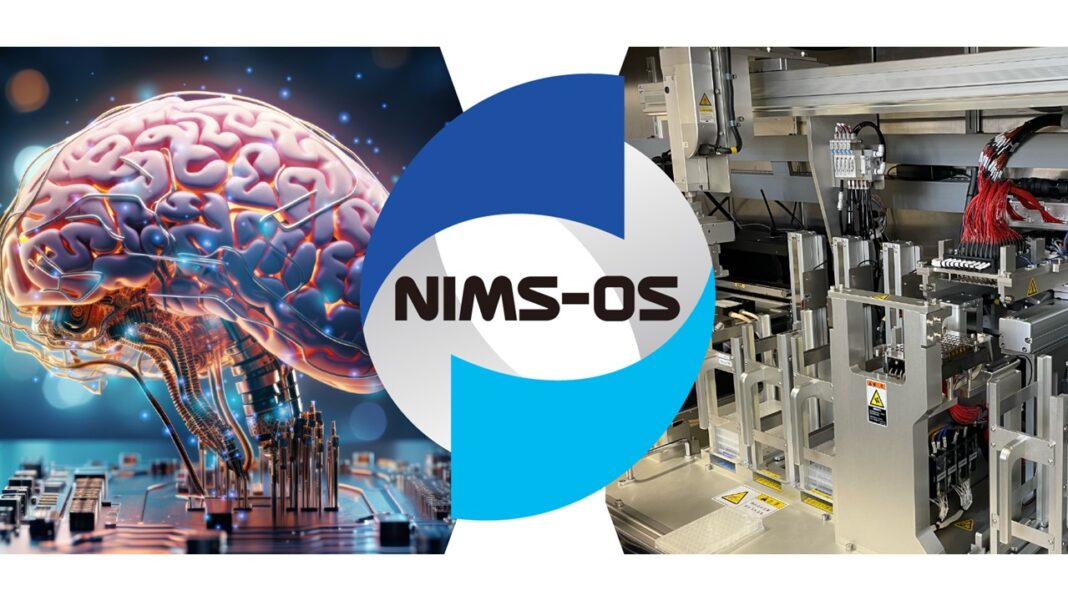


The powers of artificial intelligence (AI) and robotic experiment systems have come together in pioneering proof-of-concept work at the National Institute for Materials Science (NIMS) in Japan. The researchers describe the development and demonstration of their “closed loop” automation software in the journal Science and Technology of Advanced Materials: Methods.
“The overall aim of our work is to allow experiments exploring materials science to be designed and then proceed automatically, with no human intervention,” says physicist and software engineer Ryo Tamura at the NIMS Center for Basic Research on Materials. The AI first performs the information gathering and experimental design tasks normally done by humans, and then controls the robotic systems that can execute the required physical tasks.
The team demonstrated the potential of their system by using it to identify electrolytes that would be suitable for mediating the movement of ions in lithium-metal batteries.
The software, called the NIMS Orchestration System (NIMS-OS), contains two basic types of modules. The first uses AI algorithms to explore archived data on the properties of materials. It selects promising materials and proposes experimental procedures that would allow them to achieve a desired aim. The second type of module generates the instructions needed to control a robotic system that will put the instructions into practice.
To make the whole process as easy to use as possible for a wide range of researchers the team also designed an easy-to-use graphical user interface to control it.
“The results of initial work by the robotic system via NIMS-OS can be fed back to refine the AI algorithms that control it, through several cycles of test and improvement,” says Tamura.
In the proof-of-concept task that explored options for making electrolytes that maximize the performance of an electrode in a lithium-metal battery, NIMS-OS utilized systems that were robotically assembled into electrochemical cells and subjected to charging and discharging cycles to analyze their performance. The results clearly identified the better electrolyte composition and indicated there is room for improvement on the electrolytes that are currently widely used commercially.
“Our NIMS-OS is now publicly available as open-source software at the widely used GitHub website,” says Tamura. “We now plan to develop it further to allow it to work together with many different types of robotic experiment systems.”
For more information, please visit www.nims.go.jp.


%20and%20robotic%20experiment%20systems%20have%20come%20together%20in%20pioneering%20proof-of-concept%20work%20at%20the%20National%20Institute%20for%20Materials%20Science%20(NIMS)%20in%20Japan.%20The%20researchers%20describe%20the%20development%20and%20demonstration%20of%20their%20%E2%80%9Cclosed%20loop%E2%80%9D%20automation%20software%20in%20the%20journal%20Science%20and%20Technology%20of%20Advanced%20Materials:%20Methods.)